
Choosing the right air conditioning system for a commercial property in the UAE involves more than comparing equipment prices. The system must handle high outdoor temperatures, meet the building’s cooling demand, control energy consumption and maintain comfortable indoor conditions throughout the year.
Split AC units, Variable Refrigerant Flow (VRF) systems and chillers each serve different requirements. The right option depends on your property’s size, room layout, operating hours, occupancy patterns, installation budget and long-term maintenance needs. Understanding these differences helps property owners, developers and facility managers make a practical decision before installation or renovation.
Before selecting an air conditioning system, consider how your property is used daily. A small office with a few enclosed rooms has different cooling needs from a hotel, shopping centre or multi-floor commercial building.
Three factors deserve particular attention:
A system that works well in one commercial property may be inefficient or unnecessarily expensive in another. Accurate cooling-load calculations should therefore guide the decision rather than floor area alone.
Commissioning should not begin while major installation work is still incomplete.
The first step is to confirm that the HVAC installation is physically ready for testing. This means checking that equipment, ductwork, pipework, insulation, controls and electrical connections have been completed sufficiently for meaningful testing.
Split air conditioning systems consist of an indoor unit and an outdoor unit connected through refrigerant piping. They are widely used in smaller commercial premises where individual rooms can be cooled independently.
Split AC units can be suitable for:
Their main advantage is straightforward installation. Each unit can serve a specific room, allowing businesses to cool occupied spaces without necessarily operating equipment throughout the entire premises.
Initial investment: Split AC systems can be economical when only a few rooms need cooling. However, installing numerous separate units across a large building can increase the combined equipment, piping and installation costs.
Energy consumption: Individual room control can help reduce unnecessary cooling. Actual savings depend on equipment efficiency, thermostat settings, usage and maintenance.
Outdoor space: Every separate system generally requires an outdoor unit. Multiple units may create space, access, appearance and maintenance challenges, particularly in buildings with limited external areas.
Maintenance: Each unit needs appropriate filter cleaning, coil inspection, drainage checks and servicing. Managing many units can become more demanding as the property grows.
For a small commercial property, split AC may provide a sensible balance between installation cost and flexibility. For a large premises with many rooms, it is worth comparing the total cost of multiple split units against a centralised or multi-zone solution.
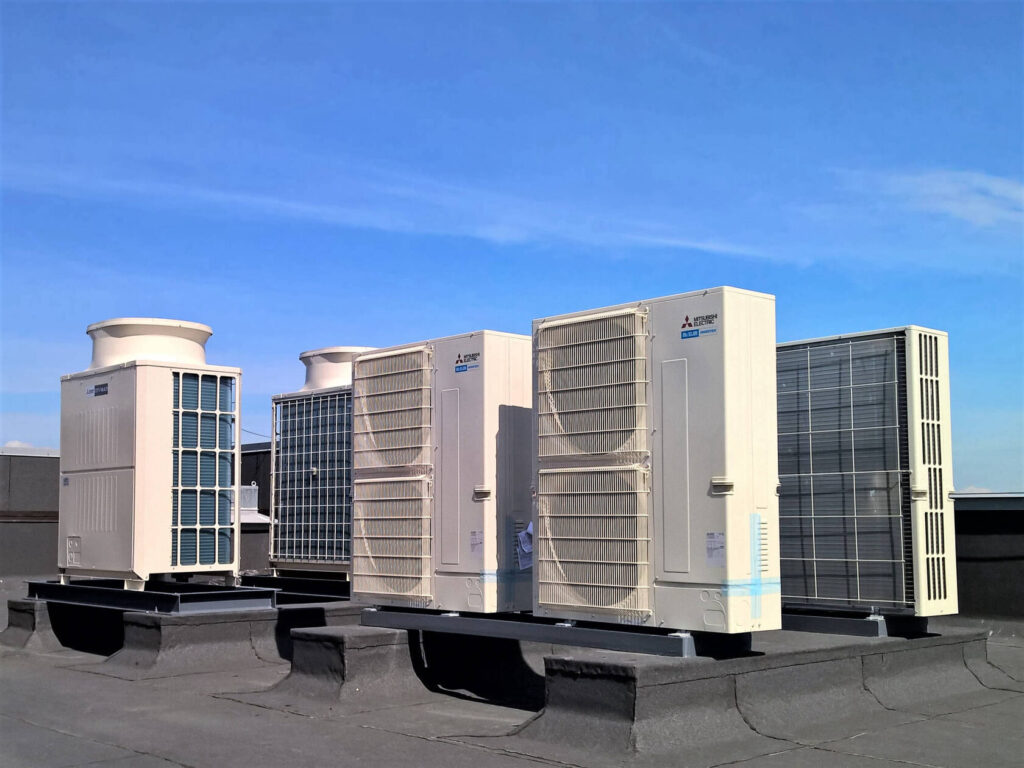
Variable Refrigerant Flow, commonly called VRF, uses a shared outdoor system connected to multiple indoor units. It adjusts refrigerant flow according to the cooling or heating demand of different zones, depending on the system design.
This makes VRF an option for commercial buildings where rooms have different usage schedules and temperature requirements.
VRF systems are often considered for:
For example, a commercial office may have meeting rooms that are occupied only during certain hours, while reception and workstations remain in use throughout the day. A properly designed VRF system can adjust operation to suit varying zone demands rather than treating every area as one uniform space.
Individual zone control: Different rooms can have separate temperature settings, helping occupants maintain comfort according to their needs.
Space flexibility: Multiple indoor-unit styles can be selected to suit the layout, including wall-mounted, cassette and concealed ducted options.
Part-load operation: Because the system can vary its output, it may perform efficiently when only some areas require substantial cooling. Actual performance depends on equipment selection, climate conditions, controls and installation quality.
Reduced outdoor-unit clutter: Several indoor units can connect to a shared outdoor system, potentially reducing the number of separate outdoor units compared with individual split AC installations.
Not necessarily. VRF systems require careful refrigerant-piping design, equipment coordination, commissioning and ongoing specialist maintenance. The initial investment can also be higher than a basic split AC installation.
The design must account for refrigerant piping limits, indoor and outdoor operating conditions, ventilation requirements and applicable safety standards. Businesses should compare the total installed cost and expected operating performance instead of choosing VRF solely because it is a newer technology.
Chiller systems cool water, which is circulated through air-handling units or fan coil units to provide cooling within the building. Depending on the design, the chiller may be air-cooled or water-cooled.
Unlike a typical split AC installation, a chiller system uses central equipment to serve multiple areas across a larger property. This can make it suitable for buildings with substantial and relatively continuous cooling requirements.
Chiller systems are commonly considered for:
These properties may require coordinated cooling across multiple floors, extensive occupied areas and spaces with different internal heat loads.
Centralised cooling: Major cooling equipment is located in a central plant, while chilled water distributes cooling throughout the building.
Large-capacity operation: Chillers can be designed for substantial cooling demands that would be difficult to manage efficiently with numerous individual AC units.
Building-wide control: Centralised controls can help facility teams monitor system performance and coordinate cooling schedules.
Potential efficiency at scale: Well-designed chiller plants can deliver strong efficiency for large cooling loads. However, performance depends on chiller type, plant sizing, pumps, cooling towers where applicable, controls and operating conditions.
Chillers generally require more extensive planning than individual split units. Depending on the design, the project may need a plant room, chilled-water piping, pumps, air-handling equipment, cooling towers and dedicated maintenance access.
Installation costs and technical complexity can be substantial. Water-cooled systems also require appropriate water management and treatment. For smaller properties with intermittent cooling needs, this infrastructure may not be justified.
A chiller is therefore best assessed as part of the building’s complete mechanical design, rather than as an isolated equipment purchase.
The best cooling system is not always the one with the lowest purchase price or the highest rated efficiency. It is the one that meets the building’s demand reliably without creating unnecessary installation and operating costs.
If upfront simplicity matters: Split AC units may suit small premises with limited cooling requirements and straightforward room layouts.
If room-by-room control matters: VRF can be a strong candidate for buildings with multiple zones, varied occupancy and changing cooling demand.
If the building needs large-scale central cooling: A chiller system may be more appropriate for extensive commercial developments with significant, sustained cooling loads.
These are starting points, not fixed rules. A well-designed VRF installation may suit some larger buildings, while a chiller may be excessive for a small office. The building’s actual cooling profile should determine the final choice.
Equipment that is too small may struggle to maintain comfortable temperatures during peak UAE summer conditions. Oversized equipment can increase capital costs and may operate inefficiently under certain conditions. Cooling calculations should consider the building envelope, occupancy, equipment loads, ventilation and local design conditions.
Look beyond the quotation. Compare installation, electricity consumption, routine maintenance, replacement parts and likely future upgrades. A higher initial investment may be worthwhile if the system better matches the building’s operating pattern.
Consider whether additional rooms, tenants or equipment may increase cooling demand. The chosen system should support realistic future needs without requiring avoidable redesign or major modifications.
There is no single cooling system that is best for every UAE commercial property. Split AC units offer simplicity for smaller spaces, VRF systems provide flexible multi-zone control, and chillers can support the substantial cooling demands of larger buildings.
The most suitable option emerges from a proper assessment of cooling loads, occupancy, building layout, energy performance, installation constraints and long-term operating costs. It is also important to verify that the proposed equipment and installation comply with the relevant local requirements.
For commercial property owners and developers evaluating these options, Multiline Projects can be considered as a partner for assessing project requirements and planning suitable building solutions. A well-informed decision at the design stage helps establish a cooling system that supports occupant comfort, operational reliability and the property’s long-term needs.
WhatsApp us
Adding {{itemName}} to cart
Added {{itemName}} to cart