

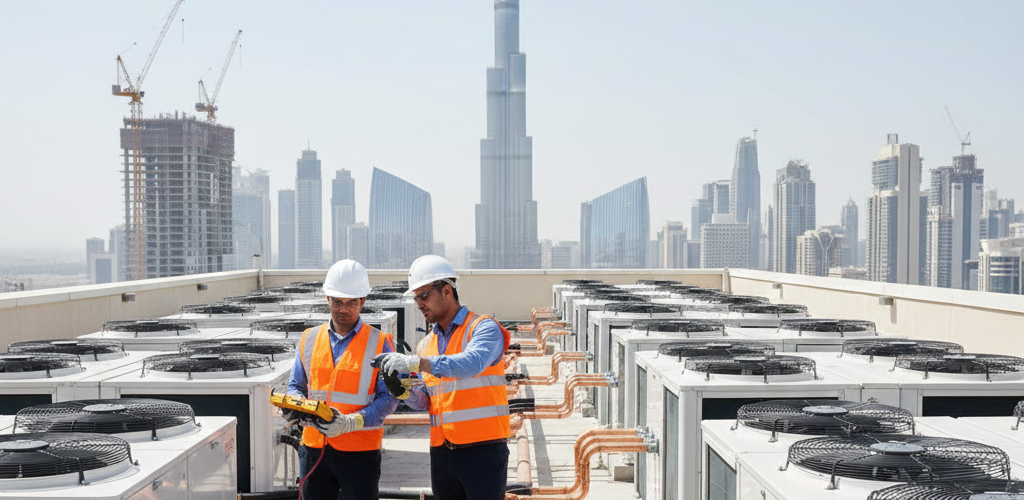
In Dubai’s extreme climate where temperatures routinely exceed 45°C, building owners and facility managers face a critical challenge: delivering consistent comfort while managing spiraling energy costs. Traditional air conditioning systems struggle under these conditions, consuming excessive electricity and failing to provide the zone-level control modern commercial buildings demand.
Variable Refrigerant Flow (VRF) system installation has emerged as the definitive solution for UAE commercial properties. At Multiline Projects, we’ve specialized in professional VRF installation across Dubai, Abu Dhabi, and the wider UAE for over 25 years, delivering energy-efficient climate control systems that reduce operating costs by 30-40% while enhancing occupant comfort.
This comprehensive guide covers everything decision-makers need to know about VRF system installation,from technology fundamentals and installation processes to cost analysis and contractor selection. Whether you’re planning new construction or retrofitting an existing facility, understanding professional VRF installation is essential for making informed HVAC investments in the UAE market.
What is VRF System Installation?
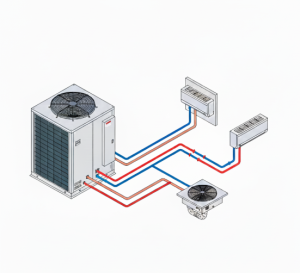
Variable Refrigerant Flow (VRF) system installation refers to the design, supply, and professional implementation of advanced HVAC technology that uses refrigerant as the primary cooling and heating medium. Unlike traditional systems that use water or forced air throughout the building, VRF systems circulate only the precise amount of refrigerant needed to match real-time demand in each zone.
A complete VRF installation consists of:
Outdoor Condensing Units: High-capacity units housing inverter-driven compressors, condenser coils, and advanced control electronics. In UAE installations, these must be rated for high-ambient operation (up to 54°C).
Indoor Air Handling Units: Available in multiple configurations,ceiling cassettes, wall-mounted units, ducted systems, and floor-standing models. Each operates independently with individual temperature control.
Refrigerant Piping Network: Insulated copper lines connecting outdoor and indoor units. Professional VRF installation accommodates pipe runs up to 150 meters with significant elevation differences, impossible with traditional systems.
Advanced Control Systems: Digital controllers, building management system (BMS) integration, and smart monitoring capabilities enabling centralized oversight and energy optimization.
VRF vs VRV: Understanding the Terminology
Many clients ask about the difference between VRF and VRV. VRV (Variable Refrigerant Volume) is Daikin’s trademarked name for this technology, introduced in 1982. VRF (Variable Refrigerant Flow) is the generic term used by all other manufacturers,Mitsubishi Electric, LG, Samsung, Carrier, Toshiba, and others. The underlying technology is identical; only the branding differs.
For commercial VRF system installation in Dubai, both terms refer to the same advanced climate control technology that’s revolutionizing HVAC efficiency across the UAE.
How VRF Systems Work in UAE’s Extreme Climate
Understanding VRF operation is crucial for appreciating why professional installation delivers superior results in Dubai’s demanding environment.
The Operating Principle
VRF technology uses inverter-driven compressors that continuously modulate their speed to match cooling or heating demand precisely. Traditional HVAC systems operate on crude on/off cycles,running at 100% capacity then shutting down completely. This constant cycling wastes enormous energy and causes temperature fluctuations.
VRF systems continuously adjust compressor speed from 10% to 100% capacity, delivering only what’s needed. When multiple zones have different demands, the system optimizes refrigerant distribution intelligently. This means:
- Part-load efficiency: 60-70% energy savings when operating at partial capacity (which is 80% of operating time)
- Simultaneous heating and cooling: Heat recovery models can cool data centers while heating perimeter offices
- Rapid response: Inverter technology reaches setpoint temperatures 30% faster than fixed-speed systems
High-Ambient Performance for UAE
Dubai’s summer conditions push HVAC systems to their limits. Standard air conditioning equipment loses capacity dramatically above 40°C ambient temperature,exactly when buildings need maximum cooling.
Professional VRF installation in UAE specifies high-ambient rated equipment engineered specifically for Gulf conditions:
- Oversized condenser coils for enhanced heat rejection
- Compressors rated for continuous operation at 52-54°C
- Corrosion-resistant coatings for coastal environments (Dubai Marina, Jumeirah, Corniche areas)
- Enhanced refrigerant management for stable operation during peak demand
This is why VRF contractors in Dubai with local expertise matter,they specify equipment proven in UAE conditions, not just standard catalog products.
Complete VRF System Installation Process: 8 Critical Phases
Professional VRF installation demands technical precision and systematic execution. Here’s exactly how expert contractors like Multiline Projects deliver successful projects:
Phase 1: Engineering Assessment & Load Calculation
Before any equipment is specified, our engineers conduct comprehensive site analysis:
Building survey: Floor plans, ceiling heights, facade orientation, window areas, insulation values
Heat load calculation: Using ASHRAE-compliant software, we calculate precise cooling requirements room by room
Zoning strategy: Defining independent control zones based on occupancy patterns and usage
Equipment sizing: Selecting outdoor unit capacity and indoor unit types/locations
This engineering phase typically takes 3-5 days for commercial projects and determines 80% of system performance.
Phase 2: System Design & Approvals
With load calculations complete, we produce:
- Refrigerant piping schematics with pipe sizes and insulation specifications
- Electrical load schedules and circuit requirements
- Control system architecture and BMS integration design
- Submission packages for Dubai Municipality and Civil Defense approvals
Timeline: 1-2 weeks including authority approval processing
Phase 3: Equipment Procurement & Inspection
Multiline Projects sources VRF equipment exclusively from authorized UAE distributors:
- Verifying high-ambient ratings and UAE-spec configurations
- Inspecting all components pre-delivery for shipping damage
- Confirming warranty registration and technical support availability
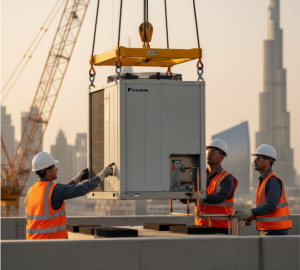
- Coordinating logistics for rooftop crane lifts or equipment hoisting
Phase 4: Outdoor Unit Installation
Our certified technicians position outdoor condensing units with precision:
Foundation preparation: Reinforced concrete pads or structural steel platforms
Vibration isolation: Commercial-grade isolators prevent noise transmission to occupied spaces
Electrical connection: High-voltage supply with proper disconnects and safety devices
Weather protection: Sunshades or enclosures that maintain airflow clearances
Critical for UAE: Outdoor units must have adequate ventilation clearance,500mm service side, 1000mm discharge side,and protection from direct afternoon sun exposure that degrades efficiency.
Phase 5: Indoor Unit Installation
Installation complexity varies by unit type:
Ceiling cassettes: Suspended from structural ceiling with plenum access for service
Ducted concealed units: Installed in ceiling voids with ductwork to multiple supply grilles
Wall-mounted: Bracket-fixed with attention to drain line routing
Floor-standing: Positioned for optimal airflow without obstructing space usage
Each unit must be precisely leveled to ensure proper condensate drainage,essential in UAE’s high-humidity environment where every indoor unit produces significant water that must drain reliably.
Phase 6: Refrigerant Piping Installation (Most Critical Phase)
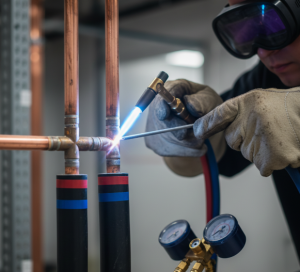
This phase separates professional VRF contractors from amateurs:
Copper pipe installation: All joints brazed with silver-bearing alloy (never compression fittings)
Nitrogen purging: During brazing to prevent internal oxidation that causes compressor failure
Insulation application: Closed-cell foam insulation prevents condensation and energy loss
Pressure testing: 24-hour pressure hold test at 550 PSI minimum
Deep vacuum evacuation: Pulling vacuum to 500 microns or lower to remove all moisture
Why this matters: Moisture or contaminants in refrigerant lines cause 80% of premature VRF compressor failures in UAE. Professional installation includes mandatory vacuum verification using calibrated micron gauges.
Phase 7: Electrical & Controls Integration
- Installing dedicated electrical circuits from main distribution
- Running communication wiring between all system components
- Programming centralized controllers with schedules and setpoints
- Integrating with building management systems (BMS) if specified
- Configuring energy monitoring and remote access capabilities
Phase 8: Commissioning & Performance Verification
Before handover, comprehensive testing ensures design performance:
Refrigerant charging: Precisely measured according to pipe length and manufacturer specifications
Capacity testing: Verifying cooling/heating output in all zones
Electrical verification: Current draw, voltage, safety device operation
Control sequence testing: Confirming all zones respond correctly
Airflow measurement: Validating proper CFM delivery at each indoor unit
Documentation: Providing as-built drawings, test reports, and O&M manuals
Typical installation timeline:
- Small office/villa (20-40 TR): 3-4 weeks
- Medium commercial (50-100 TR): 5-7 weeks
- Large tower (200+ TR): 10-14 weeks
Types of VRF Systems: Selecting the Right Technology
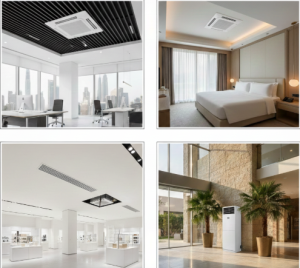
Not all VRF installations are equal. Understanding system types is essential for matching technology to application.
1. Heat Pump VRF Systems (2-Pipe)
Configuration: Provides either cooling or heating to all connected indoor units simultaneously
Best applications:
- Dubai office buildings (cooling-dominant climate)
- Retail centers and shopping malls
- Educational facilities
- Residential villas
Advantages:
- Lower initial cost (most economical VRF option)
- Simpler installation
- Excellent for UAE where heating demand is minimal
Performance: 30-35% energy savings vs traditional systems
Typical UAE pricing: AED 5,500-7,500 per TR installed
2. Heat Recovery VRF Systems (3-Pipe)
Configuration: Simultaneously cools some zones while heating others, recovering waste heat
Best applications:
- Hotels (guest rooms cooling + spa/pool heating)
- Hospitals (operating theaters cooling + patient areas)
- Mixed-use developments
- Buildings with data centers (server cooling + perimeter heating)
Advantages:
- Maximum energy efficiency (up to 40% savings)
- Hot water production from recovered heat
- Ideal for buildings with diverse simultaneous loads
Typical UAE pricing: AED 7,500-9,500 per TR installed (15-25% premium over heat pump)
3. Water-Cooled VRF Systems
Configuration: Uses water loop for heat rejection instead of air-cooled condensers
Best applications:
- High-rise buildings with existing cooling towers
- Locations with limited outdoor unit space
- Buildings requiring ultra-quiet outdoor operation
Advantages:
- Higher efficiency in hot climates
- Reduced outdoor noise
- Flexible outdoor unit placement
Typical UAE pricing: AED 8,500-11,500 per TR installed
Multiline Projects’ Recommendation Framework:
| Building Type | Recommended VRF System | Reasoning |
| Standard Office | Heat Pump (2-pipe) | Cost-effective, cooling focus |
| Luxury Hotel | Heat Recovery (3-pipe) | Diverse simultaneous needs |
| Healthcare Facility | Heat Recovery (3-pipe) | Simultaneous cooling/heating zones |
| Retail Center | Heat Pump (2-pipe) | Open-plan, cooling dominant |
| High-rise Tower | Water-cooled or Heat Recovery | Limited roof space, high efficiency |
| Residential Villa | Heat Pump (2-pipe) | Best value for money |
ROI timeline: VRF installation typically achieves payback in 3.5-5 years for commercial buildings operating 10+ hours daily.
Benefits of VRF for UAE Commercial Buildings
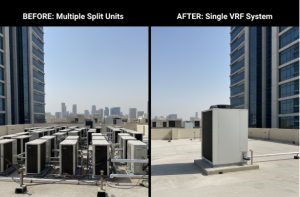
Why have VRF systems become the preferred choice for Grade-A commercial buildings across Dubai and Abu Dhabi?
1. Exceptional Energy Efficiency
VRF inverter technology delivers:
- 30-40% energy savings vs traditional HVAC in UAE climate
- Part-load efficiency: Systems operate at partial capacity 80% of the time, where VRF excels
- Heat recovery savings: Up to 20% additional savings by reusing waste heat
Real example: 50,000 sq ft office tower in Business Bay reduced DEWA bills from AED 45,000/month to AED 27,000/month after VRF installation,AED 216,000 annual savings.
2. Individual Zone Control
Every indoor unit operates independently:
- Occupants control temperature in their spaces
- Unoccupied zones can be shut down automatically
- No energy wasted cooling vacant areas
- Eliminates “hot/cold” complaints common with central systems
3. Space Savings
VRF installation eliminates:
- Central plant rooms (chillers, pumps, cooling towers)
- Extensive ductwork throughout building
- Water treatment systems
- Bulky air handling units
Result: 15-25% more usable or rentable space in commercial buildings
4. Quiet Operation
- Outdoor units: 55-65 dB(A),quieter than conversation
- Indoor units: 25-35 dB(A),barely audible
- Critical for hotels, hospitals, executive offices, residential villas
5. Flexible Installation
- Refrigerant pipes easier to route than ducts or water pipes
- Long pipe runs accommodate complex layouts
- Indoor units in dozens of styles to match architecture
- Perfect for retrofit projects with minimal building disruption
6. Reliable Performance
- Fewer mechanical components than traditional systems
- Partial system redundancy,if one indoor unit fails, others continue operating
- Advanced diagnostics for predictive maintenance
- Modern VRF systems achieve 15-20 year lifespan with proper maintenance
VRF Installation for Different UAE Applications
Professional VRF contractors tailor installations to specific building types:
Commercial Office Buildings
Typical requirements: Individual tenant control, flexible space planning, BMS integration
VRF solution: Heat pump systems with ceiling-concealed ducted units for open-plan areas, cassettes for meeting rooms
Capacity: 5-8 TR per 1,000 sq ft depending on occupancy density
Key benefits: Individual tenant metering, easy reconfiguration as tenants change, minimal maintenance disruption
Hotels & Hospitality
Typical requirements: Guest comfort, quiet operation, hot water needs, 24/7 reliability
VRF solution: Heat recovery systems for guest rooms (cooling) + pool/spa (heating), heat recovery for domestic hot water
Capacity: 1-1.5 TR per guest room
Key benefits: Exceptional quiet operation, energy cost reduction, guest-controlled comfort
Retail Centers & Malls
Typical requirements: Large open spaces, varying occupancy, extended hours, tenant divisions
VRF solution: High-capacity outdoor units with multiple cassette configurations, zone-based scheduling
Capacity: 350-450 sq ft per TR (higher density than offices)
Key benefits: Flexible tenant allocation, individual tenant billing, energy savings during low-traffic hours
Luxury Villas & Residential
Typical requirements: Aesthetic integration, quiet operation, room-by-room control, minimal outdoor units
VRF solution: Concealed ducted systems or slim-duct units, hidden piping routes, designer grille options
Capacity: 1 TR per 300-400 sq ft
Key benefits: Superior comfort vs multiple splits, cleaner exterior (fewer outdoor units), smart home integration
Healthcare Facilities
Typical requirements: Precise temperature/humidity control, infection control, redundancy, HEPA filtration capability
VRF solution: Heat recovery systems with dedicated outdoor air, HEPA filter integration, backup provisions
Key benefits: Isolated zones prevent cross-contamination, precise environmental control, energy efficiency with 24/7 operation
Choosing the Right VRF Brand for UAE Projects
Not all VRF manufacturers deliver equal performance in Gulf conditions. Based on 25 years installing and maintaining VRF systems across UAE, here’s our assessment:
Tier 1: Premium Brands
Daikin (VRV)
- Pioneer of VRF technology (40+ years)
- Excellent high-ambient performance
- Best UAE service network
- 10-year compressor warranty
- Pricing: Premium (+40-50% vs Chinese brands)
- Best for: Luxury properties, Grade-A commercial, clients prioritizing reliability
Mitsubishi Electric (City Multi)
- Industry-lowest failure rates
- Exceptionally quiet operation
- Superior controls and BMS integration
- 10-year warranty
- Best for: Hotels, healthcare, noise-sensitive applications
Tier 2: Mid-Premium Brands
LG (Multi V)
- Strong UAE market presence
- Good high-ambient performance
- AI-enhanced controls
- Largest service network in UAE
- Pricing: 25-35% below Daikin
- Best for: Commercial offices, retail, value-conscious buyers
Samsung (DVM)
- Innovative features (WindFree cassettes)
- Smart home integration (SmartThings)
- Reliable performance
- Pricing: Similar to LG
- Best for: Modern offices, tech-forward clients, residential
Tier 3: Value Brands
Haier (MRV-X)
- Certified for 60°C ambient operation
- Rapidly growing UAE presence
- Competitive pricing
- 10-year warranty
- Pricing: 40-55% below Daikin
- Best for: Budget-conscious commercial, labor camps, schools
Gree (GMV6)
- Highest indoor unit capacity (80 units)
- Good performance in hot climates
- Growing service network
- Best for: Large-capacity installations, cost-sensitive projects
Midea (V8 Series)
- Reliable mid-tier performance
- Expanding UAE distribution
- Pricing: Similar to Haier
- Best for: Standard commercial applications
Multiline Projects Brand Selection Criteria:
We recommend brands based on:
- Application: Luxury vs standard commercial
- Budget: Total cost of ownership, not just initial price
- Service availability: Local parts inventory and technician training
- Climate suitability: Proven UAE track record
- Warranty: Comprehensive coverage with responsive claims
As authorized contractors for all major VRF brands, we provide objective recommendations aligned with your specific project requirements and budget.
VRF Installation Best Practices & Common Mistakes to Avoid
Professional VRF installation demands precision. Here’s what separates expert contractors from those who cause expensive problems:
Critical Best Practices:
✓ Accurate load calculation: Room-by-room analysis using ASHRAE standards, not rules of thumb
✓ Proper pipe sizing: Following manufacturer charts precisely for capacity and oil return
✓ Nitrogen purging during brazing: Prevents oxidation that causes compressor failure
✓ Deep vacuum evacuation: 500 microns minimum for 24+ hours removes all moisture
✓ Precise refrigerant charging: Weighed charge based on pipe length, not pressure readings alone
✓ Adequate outdoor unit clearances: Maintains efficiency in high-ambient conditions
✓ Proper condensate drainage: Critical in UAE humidity,sized traps, accessible cleanouts
✓ Quality insulation: Prevents condensation and energy loss on all refrigerant lines
Common Installation Mistakes (That Void Warranties):
Undersized equipment: Using 1 TR per 400 sq ft “rule” without actual load calculation leads to inadequate capacity during Dubai summers
Inadequate vacuum: Quick 30-minute vacuum leaves moisture that forms acids, corroding compressors within 2-3 years
Compression fittings on refrigerant lines: Amateur shortcut that causes leaks,all joints must be properly brazed
Mixed brands: Using third-party indoor units with manufacturer’s outdoor unit causes communication errors and voids warranty
Poor condensate drainage: Inadequate slope or trap sizing causes water leaks damaging ceilings
Insufficient outdoor unit ventilation: Blocked airflow reduces capacity and efficiency, especially critical in 50°C ambient conditions
Skipping commissioning: Turning system on without proper testing hides defects that surface after warranty period
No high-ambient protection: Using standard-rated equipment in UAE conditions leads to premature failure
Why professional VRF contractors matter: These mistakes are expensive,compressor replacement costs AED 15,000-30,000 per outdoor unit, often not covered under warranty if installation was improper.
VRF Commissioning & Testing: Ensuring Peak Performance
Professional commissioning is the difference between a VRF system that performs as designed and one plagued by issues.
Multiline Projects Commissioning Checklist:
Refrigerant System Verification:
- Leak testing all piping at 550 PSI
- Vacuum level verification (<500 microns)
- Refrigerant charge verification by weight
- Operating pressure and temperature readings at design conditions
Electrical Systems:
- Voltage verification within ±10% of nominal
- Current draw comparison to nameplate ratings
- Ground fault protection testing
- Emergency disconnect operation verification
Control Systems:
- Communication verification between all units
- Temperature sensor calibration
- Scheduling and setback programming
- BMS integration testing (if applicable)
- Remote monitoring activation
Performance Testing:
- Airflow measurement at each indoor unit (CFM)
- Supply air temperature verification
- Sound level measurement
- Zone response time testing
- Energy monitoring baseline establishment
Documentation:
- As-built drawings showing actual pipe routes and sizes
- Refrigerant charge records
- Electrical test reports
- Warranty registration confirmation
- Owner’s operation and maintenance manuals
- Training completion certificates for facility staff
Typical commissioning duration: 3-5 days for 50-100 TR systems
Why Choose Multiline Projects for VRF System Installation in UAE
Not all VRF contractors deliver equal results. Here’s what distinguishes Multiline Projects as UAE’s trusted VRF installation specialist:
1. Proven Track Record
- 25+ years MEP experience in UAE market
- 500+ successful VRF installations completed
- Projects across all emirates: Dubai, Abu Dhabi, Sharjah, RAK, Fujairah
- Diverse portfolio: Commercial towers, hotels, villas, healthcare, retail, industrial
- Zero warranty denials: Our installations consistently meet manufacturer standards
2. Factory-Certified Technical Expertise
Our engineers and technicians hold:
- Manufacturer-specific VRF installation certifications (Daikin, Mitsubishi, LG, Samsung)
- HVAC Excellence certifications
- Dubai Municipality approved contractor status
- Refrigerant handling licenses (EPA equivalent)
- Safety certifications for working at heights
- BMS integration certifications (BACnet, Modbus)
We don’t subcontract critical work,all installations performed by our full-time, trained staff.
3. Engineering-First Approach
Unlike contractors who install “standard” solutions:
✓ Detailed heat load calculations using Carrier HAP or Elite CHVAC software
✓ Custom zoning strategies based on your occupancy patterns
✓ Energy modeling projecting actual operating costs
✓ Value engineering optimizing performance within budget
✓ 3D BIM coordination for complex projects avoiding conflicts
4. Quality Equipment & Full Warranties
As authorized distributors for tier-1 manufacturers:
- Genuine equipment with full manufacturer warranties (5-10 years)
- Factory-level technical support for complex issues
- Guaranteed parts availability throughout UAE
- Latest high-ambient technology proven in Gulf conditions
- Extended warranty options available
5. Transparent, Competitive Pricing
What you get:
- Detailed line-item quotations (no hidden costs)
- Multiple equipment options at different price points
- Clear payment milestones tied to project stages
- No surprise change orders
- Written performance guarantees
6. Turnkey Project Management
Single point of contact for:
- MEP design and load calculations
- Authority approvals (Dubai Municipality, Civil Defense, DEWA)
- Equipment procurement and logistics
- Professional installation and testing
- BMS integration and commissioning
- As-built documentation and training
- Ongoing maintenance and support
7. Post-Installation Excellence
Our commitment continues after handover:
- 24/7 emergency service: 2-hour response for critical failures
- Comprehensive AMC programs: Preventive maintenance preventing breakdowns
- Remote monitoring: For large installations, 24/7 system oversight with predictive diagnostics
- Parts inventory: Critical spare parts stocked locally for faster repairs
- Performance guarantees: We stand behind our installations with measurable commitments
8. ISO 9001:2015 Certified Quality
Our quality management ensures:
- Standardized installation procedures
- Multi-point quality inspections
- Complete documentation and traceability
- Continuous improvement based on client feedback
- Consistent excellence across all projects
Frequently Asked Questions About VRF System Installation
1. How long does VRF system installation take in Dubai?
Timeline depends on project scope:
- Small villa/office (20-40 TR): 3-4 weeks
- Medium building (50-100 TR): 5-7 weeks
- Large commercial (200+ TR): 10-14 weeks
Factors affecting duration: Site accessibility, coordination with other trades, authority approval timelines, BMS integration complexity, crane/hoist requirements.
2. What is the difference between VRF and VRV systems?
VRV (Variable Refrigerant Volume) is Daikin’s trademarked name. VRF (Variable Refrigerant Flow) is the generic term used by all other manufacturers (Mitsubishi, LG, Samsung, Carrier). The technology and operating principles are identical,only the branding differs.
3. Can VRF systems operate efficiently in Dubai’s 50°C summers?
Yes, absolutely,when properly specified and installed. Modern VRF outdoor units are engineered for high-ambient operation up to 54°C. Key requirements:
- Equipment specifically rated for high-ambient operation
- Oversized condenser coils
- Adequate ventilation clearances
- Protection from direct afternoon sun
- Professional installation ensuring optimal refrigerant charge
Multiline Projects specifies only UAE-proven equipment tested in Gulf conditions.
4. How much does VRF installation cost per square foot in UAE?
Commercial installations:
- Standard office: AED 100-150/sq ft (complete system)
- Premium office/hotel: AED 150-200/sq ft
- Luxury residential: AED 180-250/sq ft
Includes: VRF equipment, installation, controls, electrical work, testing, commissioning
Variables: Equipment brand, system type (heat pump vs heat recovery), control sophistication, building complexity
5. Which VRF brand should I choose for my Dubai project?
Depends on priorities:
Maximum reliability + resale value: Daikin or Mitsubishi Electric
Best value + good performance: LG or Samsung
Budget-conscious large projects: Haier or Gree
As authorized contractors for all major brands, Multiline Projects provides objective recommendations based on your application, budget, and long-term service requirements.
6. Can VRF systems be retrofitted in existing buildings?
Yes,VRF retrofit is one of the most popular UAE applications. Advantages:
- Minimal disruption (can install floor-by-floor while occupied)
- No ductwork demolition required
- Flexible piping routes through existing service paths
- Dramatic energy reduction (40-50% vs old equipment)
We’ve successfully retrofitted dozens of Dubai buildings from 1980s-90s construction.
7. How much can I save on DEWA bills with VRF?
Typical savings: 30-40% vs traditional HVAC systems
Real example: 50,000 sq ft office tower:
- Before VRF: AED 540,000/year (traditional chiller system)
- After VRF: AED 324,000/year
- Annual savings: AED 216,000
- Payback period: 4.2 years
Savings vary based on operating hours, occupancy patterns, and existing system efficiency.
8. Do VRF systems require three-phase electrical power?
Commercial systems (above 10 TR): Yes, three-phase 380-415V required
Small residential systems (under 10 TR): No, can operate on single-phase 220-240V
During design, Multiline Projects coordinates with electrical consultants ensuring adequate power supply and proper circuit protection.
9. What maintenance does a VRF system need in UAE climate?
Essential maintenance:
- Monthly: Air filter cleaning (critical in dusty environment)
- Quarterly: Coil cleaning, drain line maintenance, system check
- Annually: Comprehensive service including refrigerant check, electrical testing, performance verification
We strongly recommend AMC (Annual Maintenance Contract) for commercial installations. Proper maintenance extends system life to 15-20 years and maintains energy efficiency.
10. Does Multiline Projects offer financing for VRF installation?
Yes, we arrange project financing through banking partners for qualified commercial clients:
- Equipment lease-to-own arrangements
- Energy savings performance contracts (ESPC)
- Deferred payment terms for large projects
- Government/semi-government payment terms
Contact our team to discuss financing solutions aligned with your cash flow requirements.
Ready to Transform Your Building’s Climate Control?
The decision to install a professional VRF HVAC system is an investment in long-term operational efficiency, occupant comfort, and environmental sustainability. In Dubai’s extreme climate and rising energy cost environment, VRF technology delivers proven 30-40% savings while enhancing building value.
Why Act Now?
Energy costs rising, DEWA tariffs continue increasing, making VRF ROI even faster
Green building mandates, Dubai and UAE sustainability regulations favor high-efficiency HVAC
Contractor availability, Peak installation season (September-December) books months ahead
Technology incentives, Some UAE utilities offer rebates for high-efficiency system upgrades
Get Your Free VRF Installation Assessment
Multiline Projects offers complimentary consultations including:
- Professional site survey and heat load analysis
- Custom system design proposal with multiple equipment options
- Detailed cost estimate and ROI calculation
- Energy savings projection specific to your building
- No-obligation quotation with transparent pricing


No comments yet.